
Gold is often described as the oldest form of money. It is also one of the newest growth stories in central banking. Central banks hold around a fifth of all the gold ever mined, and over the last 15 years they have gone from steady sellers to some of the most persistent buyers in the market.
This article looks at which countries hold the largest official gold reserves, how central bank ownership has changed over time, and what is driving the current wave of buying.
01The largest official gold holders
According to the World Gold Council’s dataset of world official gold holdings, which is based on IMF International Financial Statistics, the official sector holds about 36,500 tonnes of gold. Holdings are heavily concentrated: the ten largest holders account for roughly two-thirds of the total.
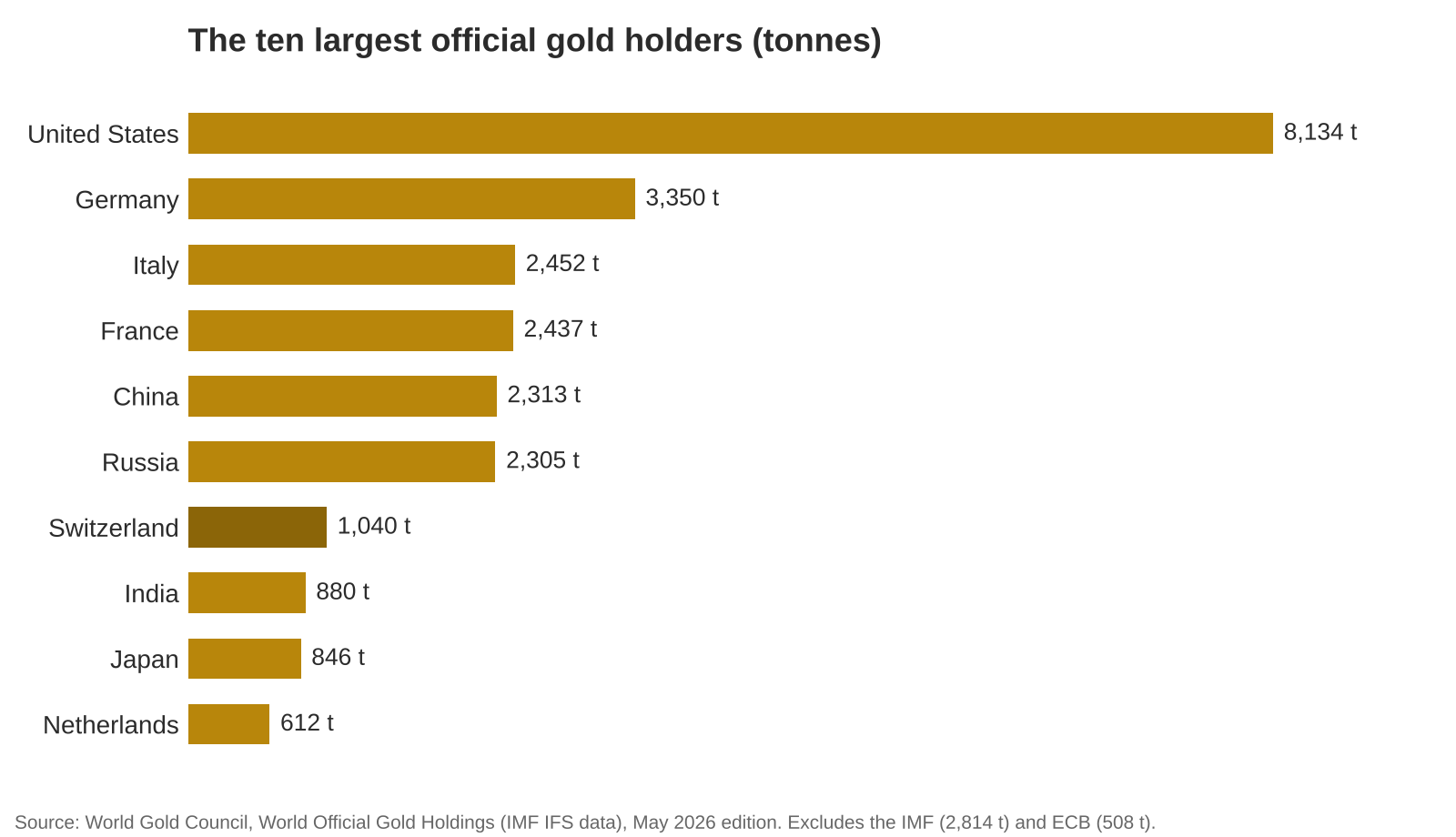
The United States remains by far the largest holder with about 8,134 tonnes, almost as much as Germany, Italy and France combined. Taken together, euro-area central banks (including the ECB) hold about 10,800 tonnes, more than the United States.
Switzerland ranks seventh with about 1,040 tonnes. Relative to its size, that is one of the largest gold positions of any country, which is one reason Switzerland is a natural home for gold custody.
The table below also shows how much of each country’s total reserves is held in gold. This is where the picture becomes more interesting.
Official gold reserves: top 15 countries
| # | Country | Tonnes | % of reserves |
|---|---|---|---|
| 1 | United States | 8,134 | 83% |
| 2 | Germany | 3,350 | 84% |
| 3 | Italy | 2,452 | 81% |
| 4 | France | 2,437 | 82% |
| 5 | China | 2,313 | 9% |
| 6 | Russia | 2,305 | 41% |
| 7 | Switzerland | 1,040 | 15% |
| 8 | India | 881 | 19% |
| 9 | Japan | 846 | 9% |
| 10 | Netherlands | 613 | 74% |
| 11 | Poland | 582 | 30% |
| 12 | Turkey | 535 | 62% |
| 13 | Uzbekistan | 416 | 88% |
| 14 | Portugal | 383 | 80% |
| 15 | Kazakhstan | 354 | 77% |
| – | IMF | 2,814 | – |
| – | European Central Bank | 508 | 56% |
| – | World total (official sector) | 36,535 | – |
Source: World Gold Council, World Official Gold Holdings (IMF IFS), May 2026 edition. Share of reserves = gold as a share of total foreign reserves, calculated by the World Gold Council. Figures are rounded and are updated monthly.
Long-standing holders in Europe and North America keep roughly 75–85% of their reserves in gold, largely a legacy of the Bretton Woods era. By contrast, some of the largest economies hold only a small share: China and Japan about 9%, India about 19%. That gap is one reason why much of today’s buying comes from emerging-market central banks.
02From sellers to buyers: how ownership has changed
Central bank gold reserves have gone through three broad phases.
- Accumulation under Bretton Woods (to the 1960s). With currencies tied to the US dollar and the dollar tied to gold, official holdings reached their historical peak in the mid-1960s.
- Decades of selling (1970s to 2000s). After the link between the dollar and gold ended in 1971, gold’s monetary role faded. Through the 1990s and early 2000s, many central banks sold gold. To keep those sales orderly, European central banks signed the Central Bank Gold Agreement in 1999, which capped sales until it ended in 2019. Switzerland, France, the Netherlands and the United Kingdom were among the largest sellers.
- The return of gold (since 2010). After the 2008 financial crisis, the trend reversed. Central banks turned net buyers towards the end of 2009 and have bought more gold than they sold every year since 2010.
Adding up the World Gold Council’s annual figures, central banks have bought more than 10,000 tonnes of gold since 2010. That is more than the official reserves of the United States.
03A step change since 2022
Buying was steady through the 2010s, averaging about 473 tonnes a year between 2010 and 2021. In 2022 it more than doubled, to a record 1,082 tonnes. It stayed above 1,000 tonnes in 2023 (1,037 t) and 2024 (1,092 t).
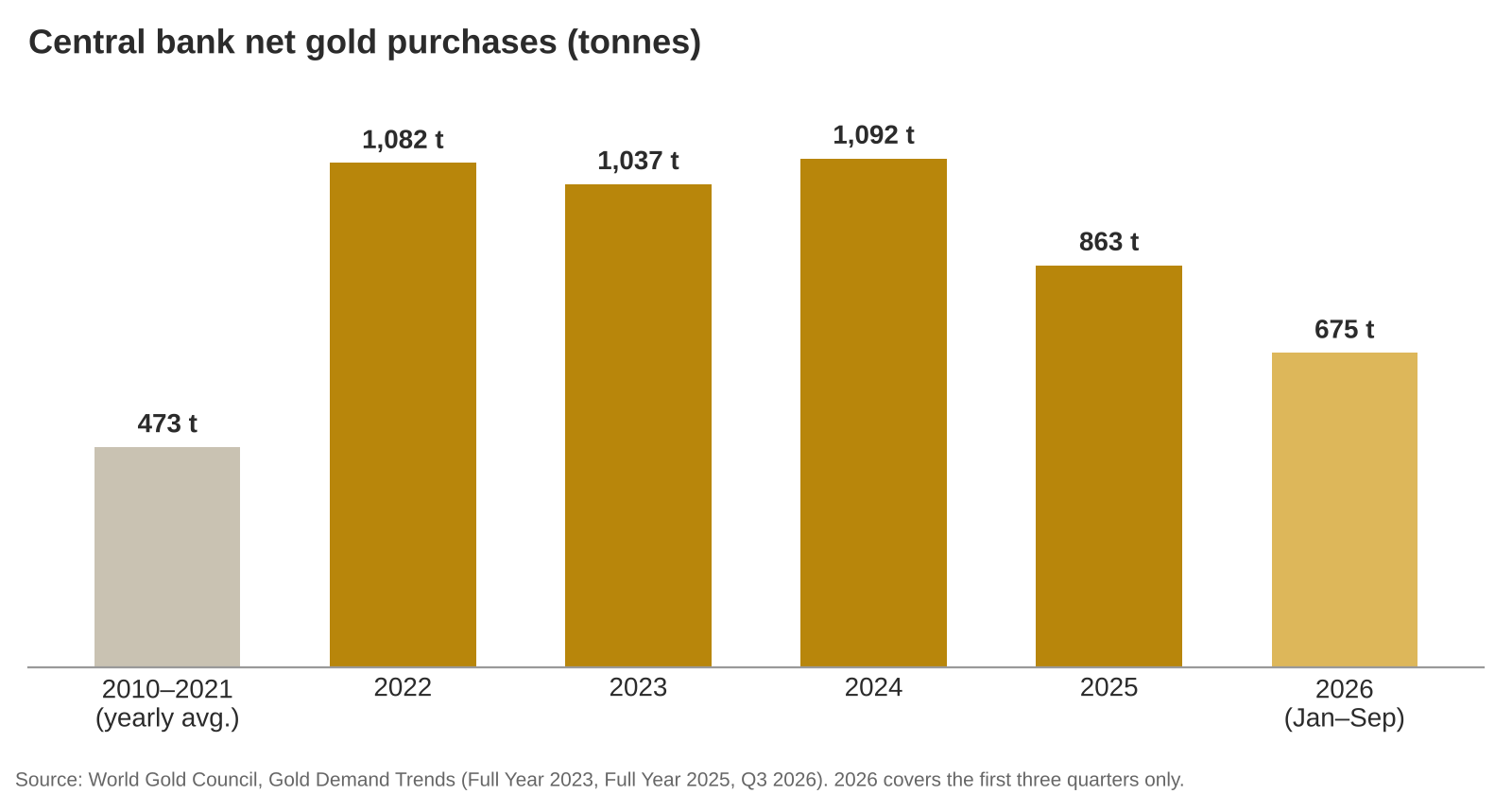
In 2025, with gold prices at record highs, buying slowed to 863 tonnes, still almost twice the 2010–2021 average. In 2026 it picked up again: central banks bought 321 tonnes in the third quarter, 42% more than a year earlier, bringing the year-to-date total to 675 tonnes, 6% ahead of 2025.
A large part of this demand is not reported country by country. The World Gold Council estimates that unreported buying accounted for 57% of the 2025 total and around 63% of third-quarter 2026 demand.
04Who is buying
The buyers are diverse, but a few names stand out:
- Poland. The largest buyer in both 2024 and 2025 (102 tonnes in 2025). Its holdings have risen to more than 580 tonnes, about 30% of reserves. The National Bank of Poland has raised its target share of gold to 30% and its governor has cited national security reasons for a long-term goal of 700 tonnes.
- China. The People’s Bank of China reported 27 tonnes of purchases in 2025 and 63 tonnes in the third quarter of 2026 alone, more than half of its year-to-date total. Gold is still only about 9% of China’s reserves.
- Kazakhstan and Uzbekistan. Both are gold producers that buy domestic output for their reserves. Kazakhstan bought 57 tonnes in 2025, its highest annual total since records began in 1993.
- Brazil, Azerbaijan, Turkey and the Czech Republic. Brazil returned to the market with 43 tonnes in late 2025. Azerbaijan’s state oil fund added 38 tonnes, Turkey 27 tonnes and the Czech National Bank 20 tonnes.
Selling has been limited. In the third quarter of 2026, Russia’s 19-tonne reduction was the only sizeable one.
05Why central banks hold gold
Central banks hold gold for its safety, liquidity and return characteristics. The World Gold Council points to long-term strategic considerations, such as diversification and risk management, as the main drivers of recent demand.
- No issuer. Gold is not someone else’s liability. It cannot be defaulted on, devalued by another country’s monetary policy or frozen by a counterparty.
- Diversification. Gold behaves differently from the government bonds and foreign currencies that make up most reserve portfolios.
- Uncertainty. Geopolitical tension and economic uncertainty have increased the value central banks place on a neutral reserve asset.
The trend looks set to continue. In the World Gold Council’s 2025 central bank survey, 95% of respondents expected global official gold reserves to rise over the following 12 months.
06What this means for individual investors
Central banks can store gold in their own vaults and move it between custodians. For individual investors, owning gold is less simple: physical metal has to be bought from a dealer, stored, insured and, if sold, shipped.
This is where tokenization comes in. CGOLD brings physical gold to the Cardano blockchain: each token represents 0.01 g of fine gold held in custody in Switzerland.
- Fractional ownership: own gold in very small amounts instead of a full coin or bar.
- 24/7 access: move gold between wallets in minutes, without moving the metal.
- Transparency: every issuance and transfer is recorded on-chain, and reserves can be checked against the on-chain supply on the Reserves page.
- DeFi utility: trade CGOLD on Cardano DEXs or use it as collateral in lending protocols.
Central banks hold gold because it is nobody’s liability and works across economic regimes. CGOLD offers individuals a way to hold the same asset with the flexibility of a digital token.
Learn how CGOLD is issued, backed and redeemed at cardanogold.ch.
Sources
- World Gold Council, Gold reserves by country (data source and methodology).
- World Official Gold Holdings, May 2026 edition (country figures as published), via Wikipedia, Gold holdings.
- World Gold Council, Gold Demand Trends Q3 2026 – Central banks.
- World Gold Council, Gold Demand Trends Full Year 2025 – Central banks.
- World Gold Council, Gold Demand Trends Full Year 2023 – Central banks.
- LBMA, The role of gold in central bank reserves.
- World Economic Forum, How central banks have used gold in the last 30 years.