
Every USD stablecoin in your wallet is, ultimately, a claim on the US dollar, and on the finances of the government that issues it. For half a century that was the safest bet in finance. Today the numbers tell a more complicated story.
This article looks at where US debt stands, how the world's largest investors are responding, and what that means for anyone who holds dollars on-chain.
01The US debt situation: a balance sheet under strain
On 26 October 2026, US gross federal debt reached $40.52 trillion, an all-time high. It passed $38 trillion in October 2025 and $40 trillion in August 2026. That is roughly $2.5 trillion of new debt in a single year, and the total has about doubled in a decade.
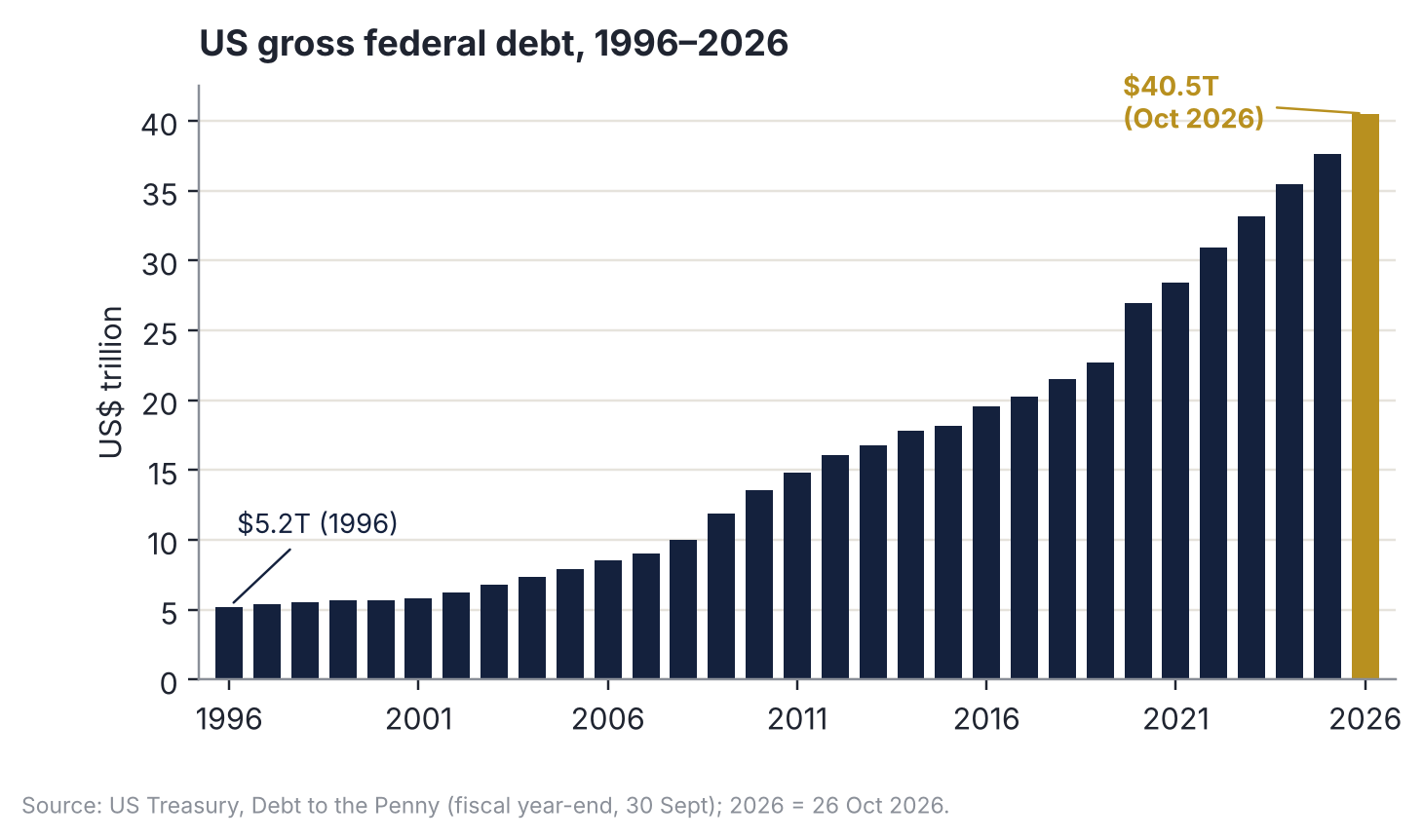
Carrying that debt is now a major budget item in its own right. In fiscal year 2026, Washington spent $7.4 trillion against $5.4 trillion of revenue, a deficit of $2.0 trillion. Net interest payments reached about $1.1 trillion, more than the $965 billion spent on national defence.
A dollar that buys less
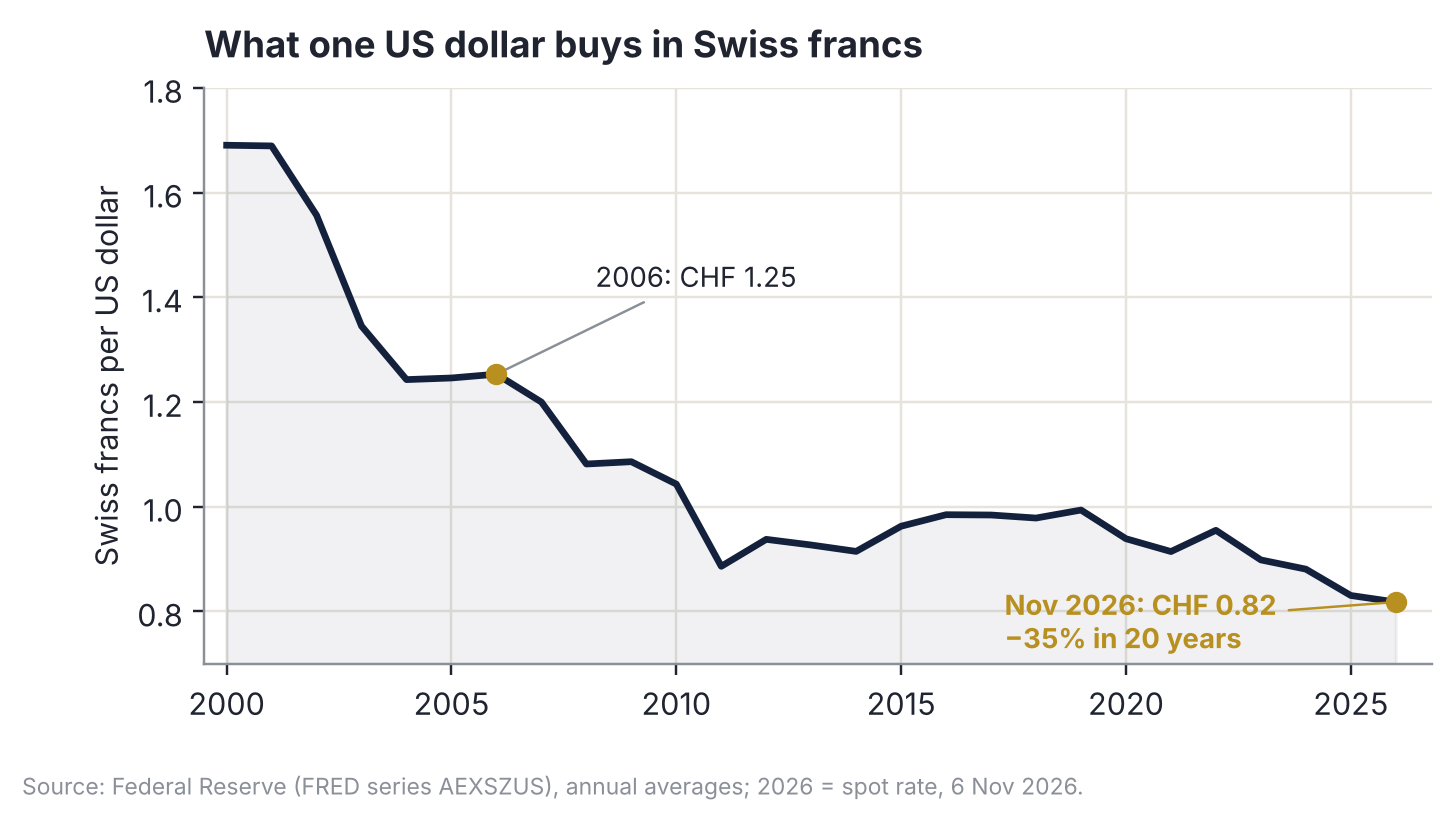
Debt on this scale has a cost for everyone who holds the currency. Measured against the Swiss franc, itself a benchmark store of value, the dollar has lost about 35% in twenty years: from an average of CHF 1.25 per dollar in 2006 to CHF 0.82 today. At home, inflation is eroding purchasing power again. US consumer prices rose 3.7% in the twelve months to September 2026.
The refinancing wall
A large part of this debt is short-dated. Treasury bills, which mature within a year, made up 22.2% of marketable debt at the end of July 2026. That is above the 15–20% range the Treasury's own advisory committee recommended in 2020. Estimates published in early 2026 put the debt due for refinancing over the following twelve months at around $10 trillion, the largest rollover on record. Every dollar rolled over at today's rates, rather than at the near-zero rates of 2020–21, adds to the interest bill.
The Federal Reserve's dilemma
A government refinancing at this scale needs low interest rates. Between September 2024 and December 2025, the Federal Reserve cut its policy rate by 1.75 percentage points, to 3.50–3.75%. Inflation did not follow. In September 2026 the Fed reversed course with its first rate hike since 2023, to 3.75–4.00%. In October, two policymakers voted for another increase.
This is the bind at the heart of the problem. Rates high enough to tame inflation make the debt more expensive to carry. Rates low enough to ease the debt burden let inflation run. Either way, the holder of dollars pays.
02How the market is reacting
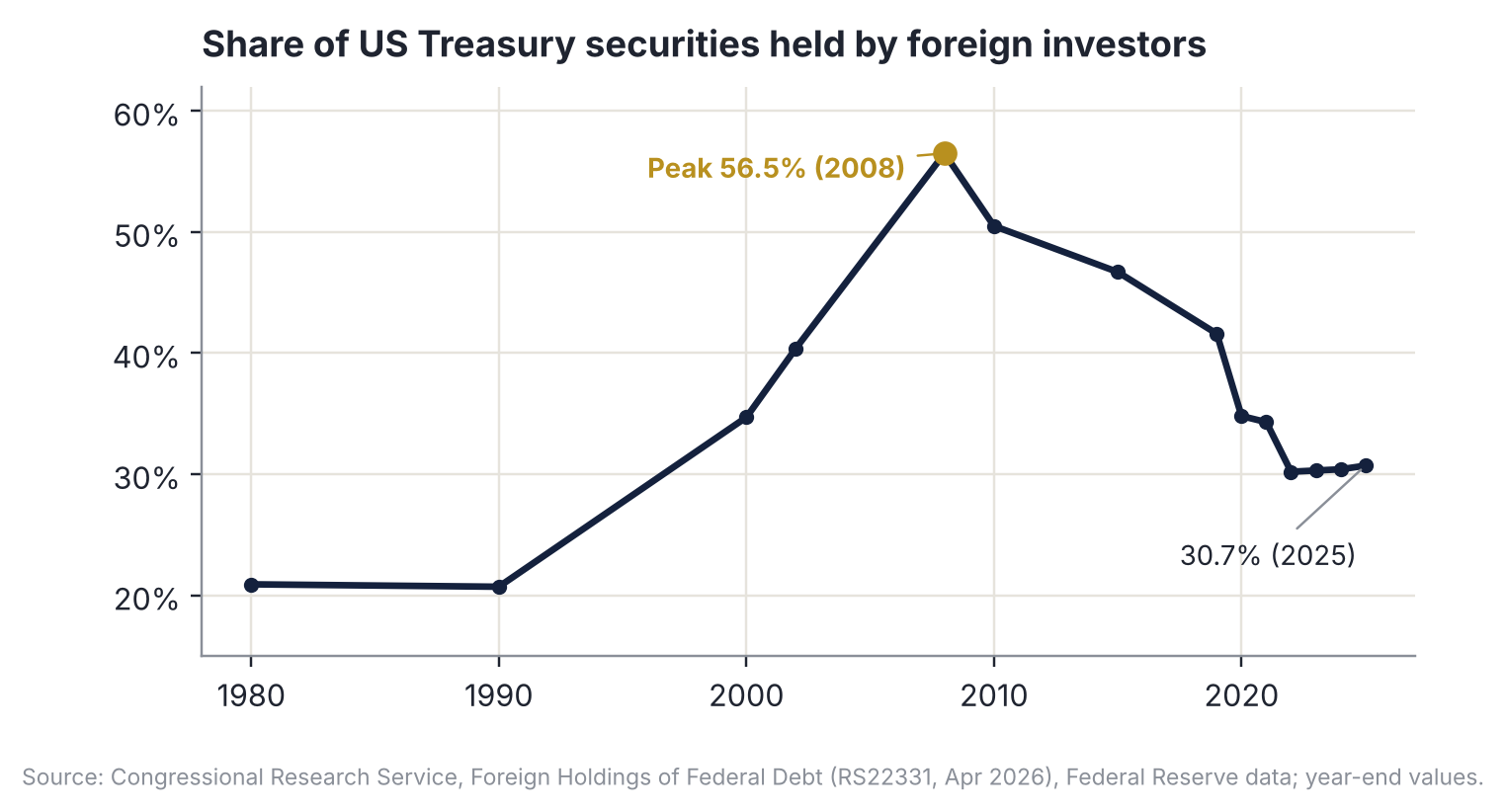
The world's investors are watching. In 2008, foreign governments and investors held 56.5% of US Treasury securities. By the end of 2025 their share had fallen to 30.7%. Foreign holdings still grew in dollar terms, to about $9.2 trillion, but they have not kept pace with issuance. The US increasingly relies on domestic buyers, and in the last resort on its own central bank.
Tariffs have not closed the gap. Customs revenue reached $195 billion in fiscal 2025 but fell to $173 billion in fiscal 2026, after roughly $130 billion of refunds on tariffs imposed under emergency powers. That is a modest sum next to a $2 trillion deficit.
Two paths, one destination
In practice, Washington has two ways to fund itself:
- Borrow short. Lean on cheaper Treasury bills to meet near-term needs. This lowers today's cost but increases the amount that must be refinanced tomorrow, at rates no one can predict.
- Turn to the Federal Reserve as buyer of last resort, financing the deficit with newly created money.
Both paths lead to the same place: more inflation and a weaker dollar in real terms.
The debt spiral
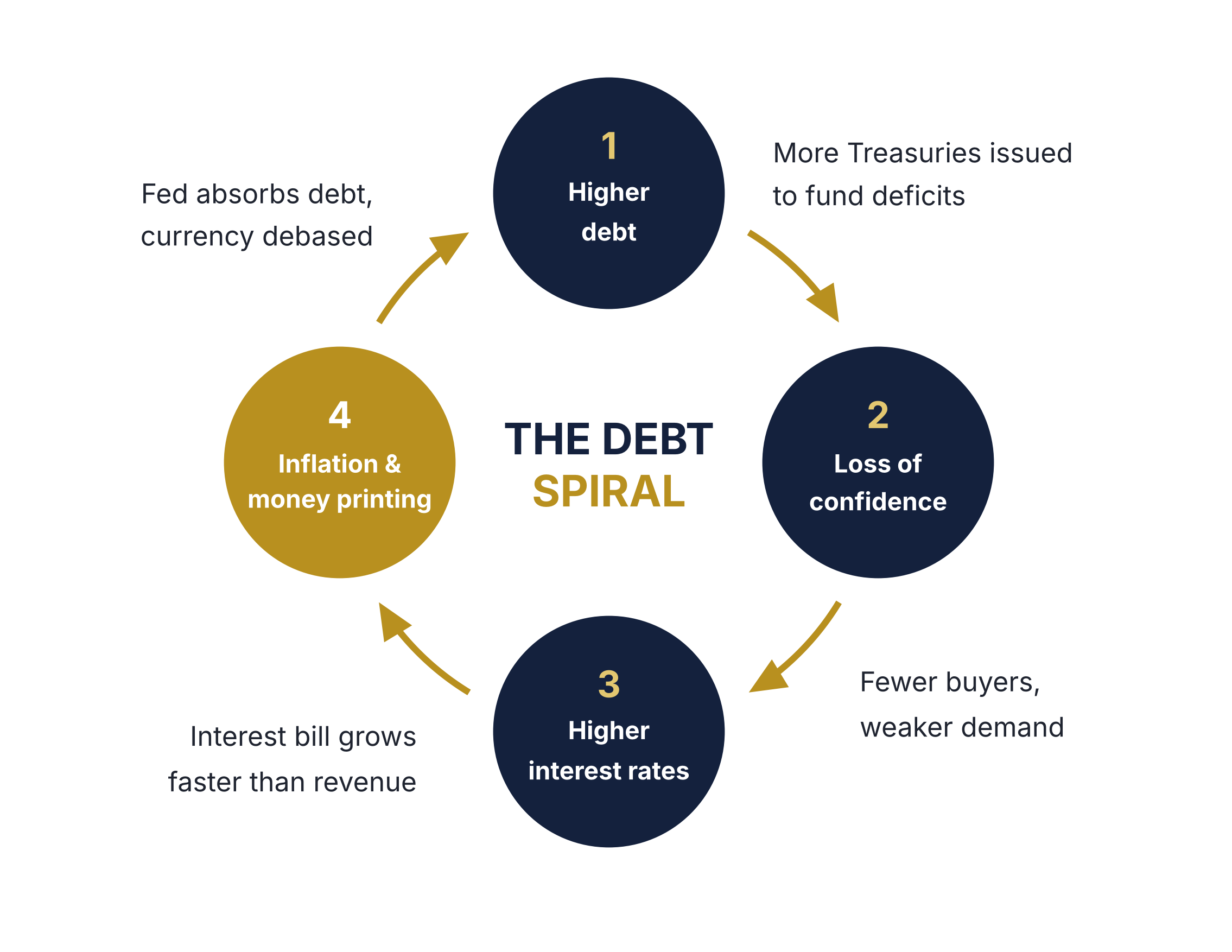
Left unchecked, these forces feed each other. Higher debt erodes confidence. Lower confidence demands higher rates. Higher rates widen the deficit, inviting money printing and inflation, which in turn require yet more borrowing.
Economists call the end state a debt trap. When interest costs grow faster than the economy, a rising share of every tax dollar goes to creditors rather than to public services. The ways out are all painful: deep spending cuts, higher taxes, restructuring, or quietly inflating the debt away. A formal default remains a tail risk. The more likely outcome is a slow erosion of the dollar's value, which is precisely what gold has historically protected against.
03How the world's largest investors are responding
Central banks, the most conservative investors in the world, have drawn their own conclusions. They bought more than 1,000 tonnes of gold in each of 2022, 2023 and 2024. In the third quarter of 2026 alone they added 321 tonnes, 42% more than a year earlier, bringing purchases for the first nine months of the year to 675 tonnes.
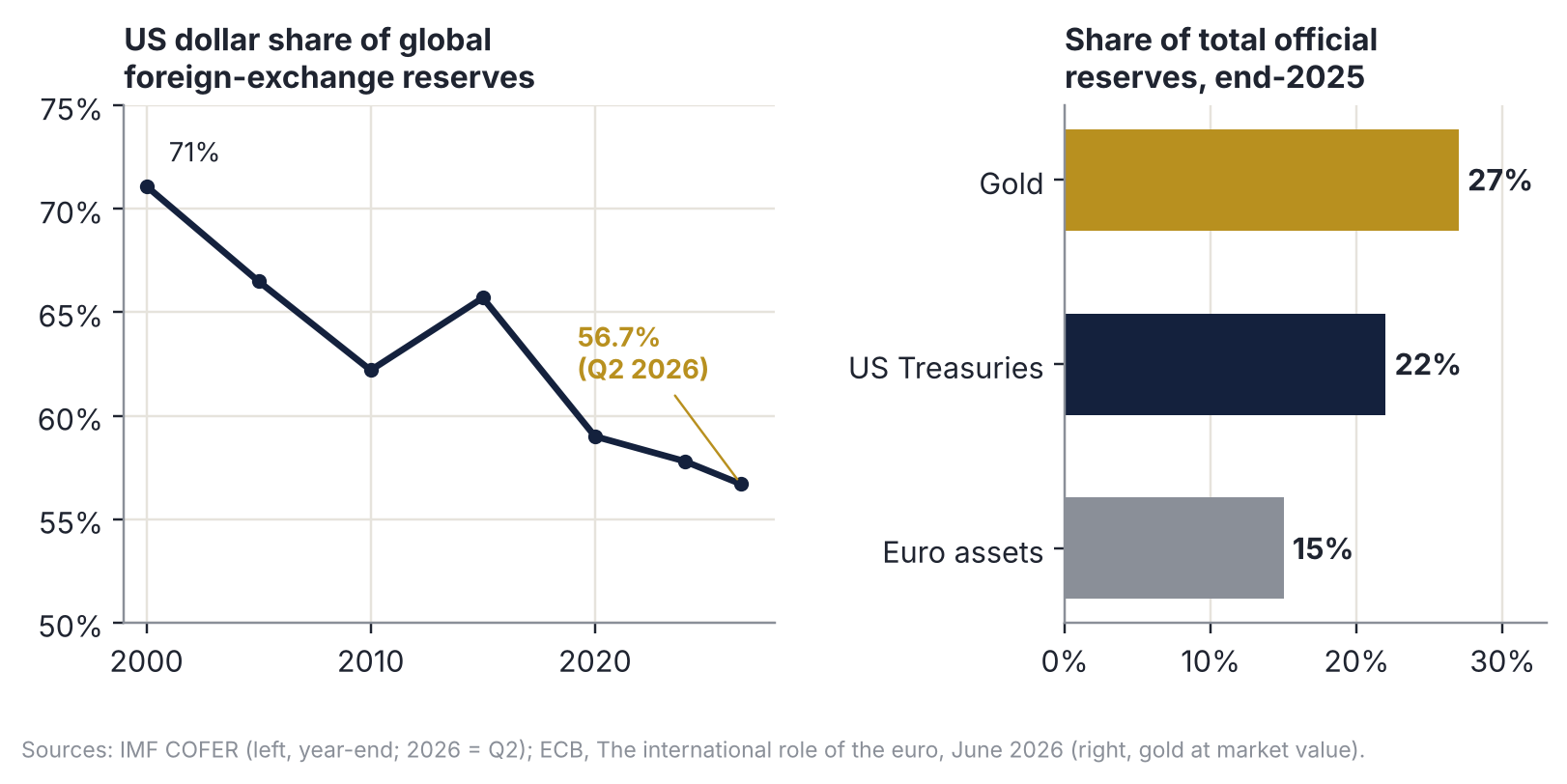
The effect on global reserves is striking. The dollar's share of the world's foreign-exchange reserves has fallen from about 71% in 2000 to 56.7% in mid-2026. According to the European Central Bank, gold made up 27% of total official reserves at the end of 2025, ahead of US Treasuries (22%) and the euro (15%).
None of this makes gold a one-way bet. After a historic run, gold peaked at $5,405 an ounce on 29 January 2026, then fell 26% to $3,994 in July as speculative positions unwound and hopes of rate cuts faded. It trades around $4,100 today. What did not reverse was central bank buying, the structural demand that underpins gold's long-term case.
04What this means for you
If you hold USD stablecoins, you carry the dollar's risks: inflation, fiscal strain and declining purchasing power. That holds even when the number on your screen never moves. A stablecoin is stable against the dollar. It is not stable against the cost of living.
Gold is a complement, not a replacement. It is no one's liability, it cannot be printed, and it has preserved purchasing power over long periods. The trade-offs are real: gold pays no yield and its price can swing sharply in the short term. For most investors the answer is not all-or-nothing, but a measured allocation that hedges the dollar exposure they already hold.
| Compared | USD stablecoin | CGOLD |
|---|---|---|
| What you hold | A claim on US dollars held by the issuer | A token backed 1:1 by physical fine gold |
| Backing | Cash and short-term US government debt | Gold vaulted in Switzerland |
| Exposure to dollar inflation | Full: purchasing power falls as prices rise | Historically a hedge against currency debasement |
| Short-term price behaviour | Stable against the dollar | Moves with the gold price |
| Income | None, unless deployed in DeFi | None, unless deployed in DeFi |
CGOLD: Swiss gold, on Cardano
- Physically backed. Each CGOLD token represents 1/100 of a gram of fine gold, backed 1:1 by physical gold. At today's prices a single token is worth a little over one dollar, so you can start small.
- Swiss custody. The gold is vaulted in Switzerland with Pro Aurum, a specialist precious-metals custodian.
- Independent controls. A trustee, Landmark, controls token issuance, Quod Agis acts as enforcer, and custody statements are published on the CGOLD Reserves page.
- On-chain liquidity. CGOLD trades on supported Cardano DEXs such as Minswap, so you can move between stablecoins and gold in a single transaction, at any hour.
- Institutional access. Authorised participants can transact directly for amounts above CHF 10,000 and, where eligible, redeem for physical gold.
How to get started
- Set up a Cardano wallet that supports native tokens.
- Fund it with ADA or the USD stablecoin you already hold.
- On a supported DEX such as Minswap, swap the portion you want to hedge into CGOLD. Always check the official token ID published on cardanogold.ch.
- Review the latest custody statement on the Reserves page, and rebalance as your view evolves.
The world's central banks have already chosen their side. They are reducing their reliance on the dollar and adding gold at a pace not seen in decades. The question for every holder of digital dollars is a simple one.
Which side will you take?
Sources
- US Treasury, Debt to the Penny (fiscal year-end data; 26 October 2026).
- US Treasury Monthly Treasury Statement, FY2026, via American Action Forum, “U.S. Treasury FY 2026 deficit totaled $2 trillion”.
- Federal Reserve, FOMC statements of 16 September and 28 October 2026.
- US Bureau of Labor Statistics, Consumer Price Index, September 2026.
- Federal Reserve Bank of St. Louis, FRED series AEXSZUS (Swiss francs per US dollar).
- US Treasury, Quarterly Refunding, August 2026; Treasury Borrowing Advisory Committee recommendations (2020).
- Congressional Research Service, Foreign Holdings of Federal Debt (RS22331), April 2026.
- IMF, Currency Composition of Official Foreign Exchange Reserves (COFER), Q2 2026.
- European Central Bank, The international role of the euro, June 2026.
- World Gold Council, Gold Demand Trends Q3 2026; LBMA Gold Price.
- CGOLD, cardanogold.ch and Reserves page.